
One of the most common questions people ask before hiring a private investigator in Sydney is simple: What do I actually get at the end? Not in theory. Not in dramatic TV terms. In practical terms.
The answer matters because most people are not paying for “suspicion confirmed.” They are paying for clear, usable documentation. That usually means a mix of written reporting, timelines, notes, and, where lawful and relevant, photos or video. The exact material depends on the job, the legal boundaries involved, and what was actually observed. In family law and many other court processes, evidence still needs to be presented properly, and the court’s main evidence format is usually an affidavit that sets out facts rather than opinions. That means the investigator’s work is often best understood as supporting material you and your lawyer may use, not as a magic file that automatically wins a case (Federal Circuit and Family Court of Australia). (Federal Circuit Court)
The short answer
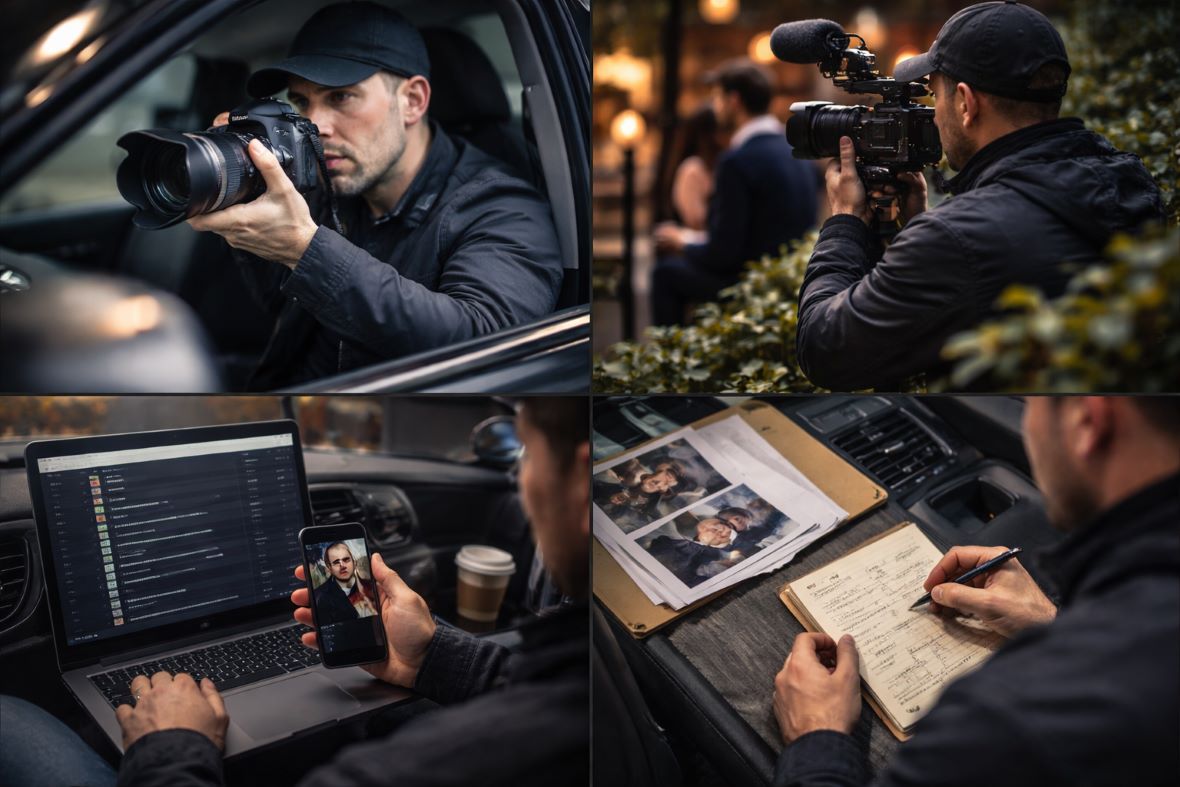
In Sydney, a private investigator will usually give you a structured report explaining what was observed, when it was observed, and why it matters. Depending on the matter, that may also include:
- time and location logs
- contemporaneous observation notes
- photographs or video with context
- identification details gathered lawfully
- supporting material that can be handed to a lawyer for review
SpouseBusters’ own surveillance investigation and Sydney content include reports, written notes, photos, videos, and, where required, physical copies of evidence, such as DVDs or tapes. Its newer content also explains that a proper surveillance outcome usually includes what was observed, when it happened, and a plain-English sequence of events (SpouseBusters).
1) A written report is usually the core deliverable
The most important thing most clients receive is not a photo first. It is the report. A good private investigator report usually pulls the matter into a clean narrative:
- what the objective was
- what dates and times were covered
- what was observed
- what was not observed
- what patterns, if any, were confirmed
This matters because evidence without context is easier to misunderstand or challenge. A photo alone may show a person somewhere. A report helps explain when, where, and how that image fits into the bigger picture. SpouseBusters’ own materials state that clients generally receive a report detailing what was observed and when, along with written notes explaining the sequence in plain language (SpouseBusters).
2) Time and location logs often matter more than people expect
A strong investigation file usually includes time and location logs. These are often less emotionally dramatic than photos, but they can be just as important. They help establish:
- start and end times
- where a person was seen
- how long they stayed
- whether a claimed routine matches what was observed
- whether repeated patterns exist across more than one day
SpouseBusters’ content specifically refers to time and location logs as part of a structured report suitable for a lawyer. That kind of record-keeping also fits how courts think about evidence. The Federal Circuit and Family Court of Australia states that an affidavit should set out facts, not opinion, which means a clean chronology matters more than speculation (Federal Circuit and Family Court of Australia; SpouseBusters).
3) Photos and videos are useful, but context is what makes them valuable
Many clients assume the “real evidence” is the photo or video. Sometimes it is. But visuals are most useful when they are supported by notes, timing, and lawful collection. SpouseBusters says its investigators may provide still photos and video when lawfully obtained, and its newer content stresses that photos or video should include context, including what happened before and after the image was captured.
That point matters because a single image can be misleading without explanation. A photo of two people together does not explain their routine, how often they met, or whether their behaviour matched what the client had been told. Context turns an image from a snapshot into evidence that is easier to understand and assess.
4) Contemporaneous notes can be just as important as footage
Clients often underestimate the value of contemporaneous notes. These are the investigator’s real-time or near-time notes describing what was actually observed, rather than remembered later. In practical terms, they can show:
- the order in which events happened
- whether someone arrived alone or with another person
- whether a person entered a venue, vehicle, or address
- whether there were long gaps, repeated stops, or relevant interactions
SpouseBusters’ content specifically describes contemporaneous notes as a core part of a professional file. This aligns with how formal evidence is usually treated more broadly. The Court’s affidavit guidance emphasises facts over opinion, which is exactly why clean, observation-based notes matter so much (Federal Circuit and Family Court of Australia; SpouseBusters).
5) In some matters, the real value is the pattern, not the single incident
A lot of people think they are hiring a private investigator for a “gotcha moment.” In reality, the value is often the pattern. A report may show:
- repeated after-hours visits to the same location
- regular contact with the same person
- frequent visits to betting venues
- routine inconsistencies that do not match the story being told
- behaviour that supports or undermines a claim in family, workplace, or financial matters
This is where private investigation work becomes more useful than isolated screenshots or a one-off observation. A structured pattern is often more credible and more helpful than one dramatic moment taken out of context. SpouseBusters’ own recent content leans heavily on this idea, showing that a proper investigation file is about pattern confirmation, not just isolated suspicion (SpouseBusters).
6) What you receive is shaped by legal boundaries
This is the part clients need to understand early. A private investigator in Sydney does not simply hand over whatever a client wishes existed. The file is shaped by what could be obtained lawfully. In NSW, the Surveillance Devices Act 2007 regulates the installation, use, maintenance, and retrieval of surveillance devices, including listening, optical, tracking, and data surveillance devices. That means lawful evidence is not just about whether something was observed. It is also about how it was obtained (NSW Legislation).
So, in practical terms, what you receive should not include unlawfully obtained private recordings, hacked account content, or material gathered by trespass or improper access. If it does, that is not a strength. It is a risk.
7) In family law matters, the investigator usually gives you material for your lawyer, not the final court document
This point is easy to miss. A private investigator typically gives you supporting evidence and reporting. The Court process itself still relies on formal evidence rules and filing requirements. The Federal Circuit and Family Court of Australia states that an affidavit is the main way to present the facts of a case to the Court, and that an affidavit should set out facts, not opinion (Federal Circuit and Family Court of Australia).
So if your Sydney matter may end up in family court, the private investigator’s report, notes, photos, and timeline often become material your lawyer reviews and uses appropriately, rather than a direct shortcut around the court process. That does not reduce the value of the investigator’s work. It clarifies what that work is for.
8) Sometimes physical copies still matter
Although most evidence is now digital, some clients still need material in a simple, handover-ready format. SpouseBusters’ Sydney page says physical copies of evidence such as DVDs and tapes can be provided for a set fee. That will not matter in every case, but it does show that deliverables may still be adapted to the practical needs of the client or lawyer (SpouseBusters).
What you should not expect
A realistic Sydney investigation file is useful because it is clean, lawful, and structured. That also means there are things you should not expect:
- a guaranteed outcome
- emotional conclusions instead of facts
- hacked phones or social accounts
- unlawful audio recordings
- “proof” that exists without context
- court success promised in advance
The best evidence is often less dramatic than clients first imagine. It is also more useful, because it can withstand scrutiny.
Conclusion
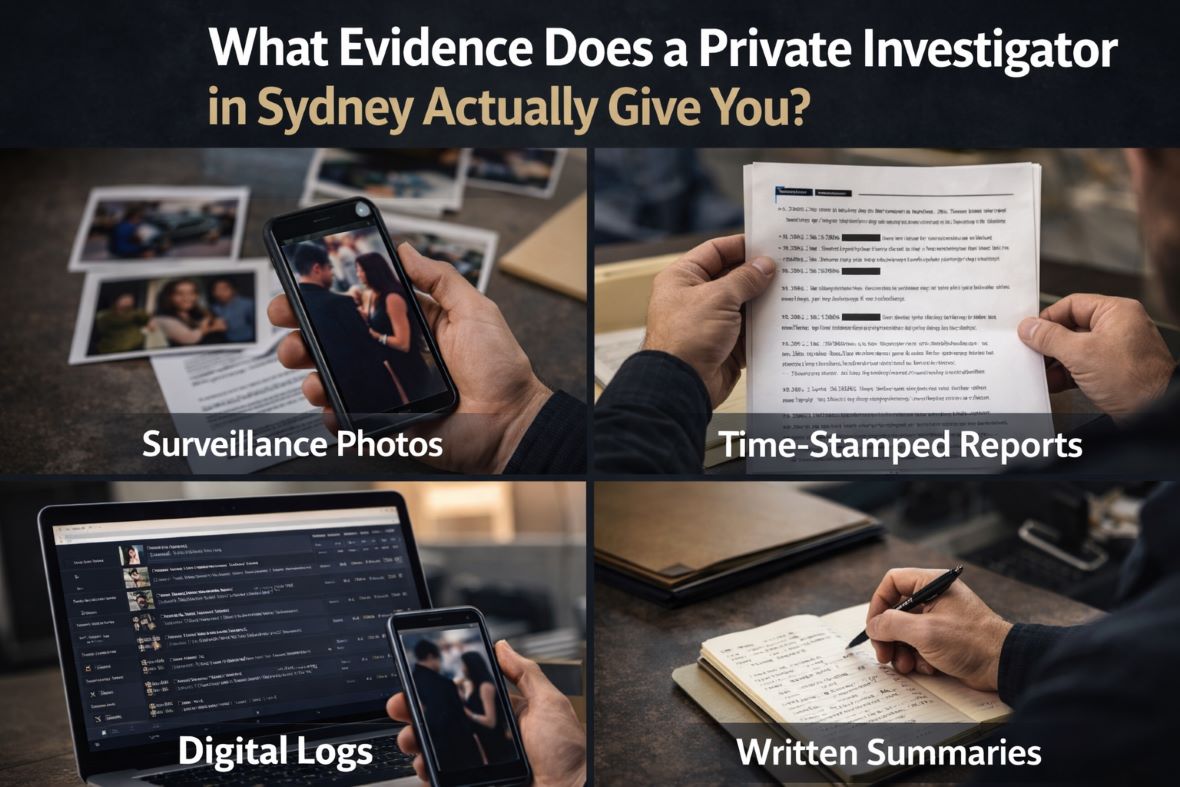
What a private investigator in Sydney actually gives you is not just “evidence” in the vague sense. It is usually a fact-based package: a report, a timeline, notes, and, where relevant and lawful, photos or video that fit into a clear sequence. That is what turns suspicion into something usable.
In real cases, the strongest file is not always the most dramatic one. It is the one that shows what happened, when it happened, how it was observed, and what it does and does not prove. That is the kind of material that helps a client make decisions calmly, and helps a lawyer decide what, if anything, should go further.
FAQ
What is the most common evidence a private investigator in Sydney gives you?
Usually, it is a written report supported by time and location logs, observation notes, and, where lawful and relevant, photos or video.
Can a private investigator’s evidence go straight into court?
Not usually by itself. In family law matters, the Court says that an affidavit is the primary means of presenting facts. An investigator’s material is often supporting evidence that a lawyer may use appropriately.
Are photos and video always the most important part?
Not always. Photos and video are useful, but they are strongest when supported by notes, timing, and context. In many cases, the pattern and chronology matter just as much as the images themselves.
References
Federal Circuit and Family Court of Australia. (n.d.). Affidavit – Family law and child support. https://www.fcfcoa.gov.au/fl/forms/affidavit
Federal Circuit and Family Court of Australia. (n.d.). Preparing an affidavit. https://www.fcfcoa.gov.au/pubs/preparing-affidavit
New South Wales legislation. (n.d.). Surveillance Devices Act 2007 No 64. https://legislation.nsw.gov.au/view/whole/html/inforce/current/act-2007-064
SpouseBusters. (n.d.). How a private investigator supports infidelity investigations in divorce cases. https://spousebusters.com.au/how-a-private-investigator-supports-infidelity-investigations-in-divorce-cases/
SpouseBusters. (n.d.). Infidelity surveillance: What a private investigator really does and why it matters. https://spousebusters.com.au/infidelity-surveillance-what-a-private-investigator-really-does-and-why-it-matters/
SpouseBusters. (n.d.). Private investigator Sydney. https://spousebusters.com.au/locations/private-investigator-sydney/
SpouseBusters. (n.d.). Surveillance of a private investigator gives insights into hidden behaviour.https://spousebusters.com.au/surveillance-of-a-private-investigator-gives-insights-into-hidden-behaviour/


