
Waiting for answers can feel like watching a kettle that won’t boil. When you hire a Private Investigator in Sydney, the first question is almost always the same, how long will this take?
The honest answer is that timelines vary a lot. Some jobs wrap up in a few hours, while others run for weeks or even months. Still, many Sydney investigations can start within 24 to 48 hours, and in some cases even the same day.
In this guide, you’ll get clear examples, typical time windows, and a simple way to estimate your own case. Most importantly, you’ll learn what really controls speed: your goal, the proof you need, what info you can provide, and the legal limits investigators must follow.
What really controls how long a Sydney investigation takes

An investigation moves at the speed of evidence. If the facts are easy to confirm, it’s quick. If the subject changes habits, it slows down. Sydney also adds its own friction; traffic, dense neighbourhoods, and busy public spaces can make observation harder.
A good investigator works efficiently, but can’t promise a fixed finish date. People cancel plans, take different routes, or stay home. New leads can also appear, and verifying them takes time.
Even the formal investigation doctrine treats time as a variable. The Australian Federal Police describes investigation duration as being shaped by complexity and risk—meaning the clearer the scope and the fewer moving parts, the faster a matter can reach a defensible endpoint.
Here are the biggest time drivers that matter to you:
- Your “done” point: Do you need peace of mind, or court-ready evidence with dates, times, and images? Higher proof standards take longer.
- How predictable the person is: A steady routine often means faster results. Erratic schedules create gaps and extra surveillance hours.
- Access to reliable identifiers: Correct names, photos, vehicle details, and addresses can shave days off the process.
- Where the activity happens: Inner-city areas can create line-of-sight problems. On the other hand, suburbs can require longer travel time between locations.
- Legal and ethical limits: A licensed PI won’t trespass or use illegal tracking methods, even if it “would be faster.”
The fastest cases are those with a clear goal and clean starting details, because the investigator spends less time confirming the basics.
If you’re looking for a local starting point, this page explains what a private investigator Sydney service typically covers, and what to expect from the process.
Case type and complexity, from quick checks to multi-week cases
Case type matters more than almost anything else. Some work is mostly records-based and can move quickly. Other work depends on being in the right place at the right time.
Typical ranges often look like this:
- Basic background checks: about 1 day to 1 week.
- Simple locate tasks (skip tracing, address confirmation): often a few days to 2 weeks.
- Complex matters (fraud-style digging, multiple sources, several interviews): often weeks to months.
Delays in case timelines are not always due to “slow work.” Research on justice shows that these delays can result from process bottlenecks and increasing system complexity, rather than just from the hours spent on investigations.
“Complex” does not typically mean “mysterious.” It usually refers to the need for multiple sources, thorough verification, and additional steps to ensure that the evidence is reliable. For instance, an investigator may need to confirm that two records refer to the same individual or verify a claim with at least two independent sources.
Surveillance time depends on routines, locations, and how much proof you need
Surveillance is where timelines get unpredictable. Even if the plan is solid, you’re still dealing with human behaviour. The subject may not leave home, may use rideshares, or may change venues at the last minute.
Sydney conditions can also add delays. Heavy traffic can break visual contact. Crowded areas can block clear photos. Some cases require unambiguous evidence, meaning clear images, clear actions, and clear timestamps.
Many infidelity surveillance matters yield useful evidence early, often within the first 72 hours, according to some PI firms. Still, some cases take multiple attempts to capture the moment that actually proves the issue.
Longer surveillance usually means more hours and sometimes more than one investigator, especially if the subject uses multiple locations or changes transport.
If you want a deeper look at how this work is documented, see these surveillance investigators’ Sydney services and what evidence can look like in real life.
Real-world examples: how long common Private Investigator jobs take in Sydney
The ranges below are typical windows, not promises. Every case has its own speed bumps, and sometimes the “easy” job turns out to have missing details.
Here’s a quick reference table first, then a plain-English breakdown.
| Investigation type | Typical start time | Common timeline | What often slows it down |
| Infidelity surveillance | 24 to 48 hours | 1 to 3 days, sometimes 1 to 3 weeks | Irregular schedules, travel, and need for clearer proof |
| Background checks | 1 to 2 days | 1 day to 1 week | Common names, record conflicts, extra verification |
| Skip tracing (locate someone) | 1 to 3 days | A few days to 2 weeks | Few leads, outdated details |
| Child custody observations | 24 to 72 hours | 1 to 3 weeks | Need to show a pattern, not one event |
| Counter-surveillance checks | 24 to 72 hours | A few days, longer if ongoing | Hard-to-reproduce incidents, tech complexity |
The takeaway is simple: database-driven work is usually faster than surveillance, and pattern-based cases take longer.
Example timelines, and what can make each one faster or slower
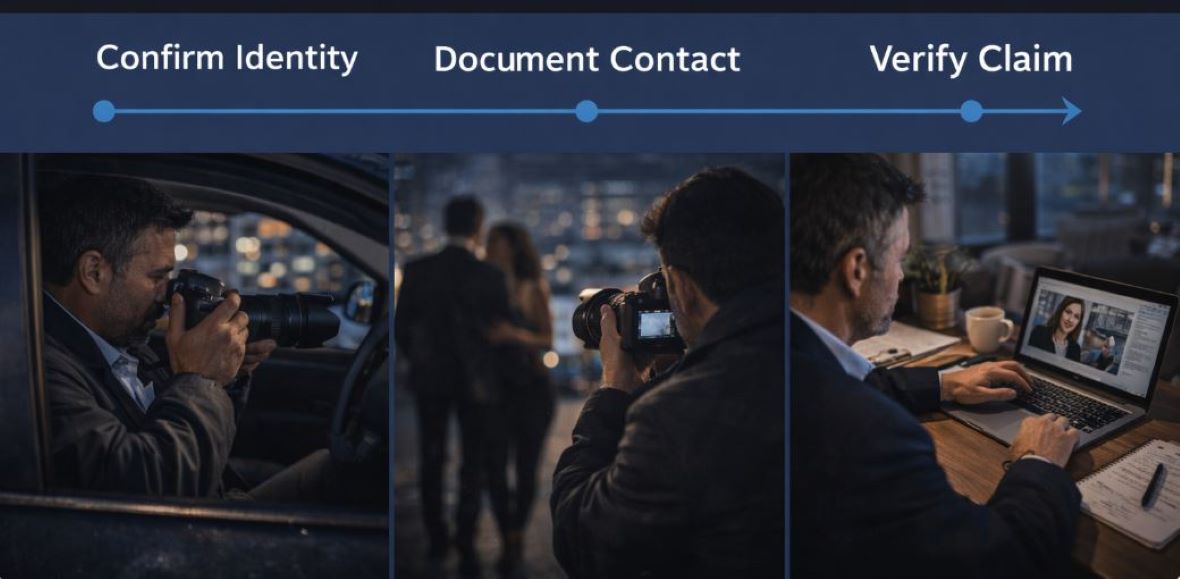
- Infidelity surveillance: Many cases can begin within 24 to 48 hours, sometimes the same day. Useful proof often shows up in 1 to 3 days, yet irregular routines can push it to 1 to 3 weeks. To speed it up, share recent photos, vehicle details, likely meetup spots, and “usual” days for suspicious behaviour.
- Background checks: A simple check can take about 1 day, while a more layered one can take up to 1 week. Delays often come from common names, multiple addresses, or records that need confirmation. You can help by providing full legal names, date of birth (if known), and past suburb or employer details.
- Locate a person (skip tracing): Many locate tasks fall in the few days to 2 weeks range. It often takes longer when the person frequently moves or uses different names. Bring any old addresses, phone numbers, email addresses, and known associates to improve the hit rate.
- Child custody-related observations: These typically take 1 to 3 weeks because courts and lawyers often focus on patterns, not one-off moments. For example, a single late school pickup might not matter, but repeated unsafe behaviour might. You can speed things up by providing a parenting schedule, school times, and accurate handover locations.
- Counter-surveillance and privacy concerns: An initial assessment can take a few days, especially if the concern is tied to a specific location, car, or office. It can be extended if the issue requires ongoing monitoring or repeated checks. To help, document dates, times, and what you noticed, and don’t discuss suspicions on a device you believe is compromised.
Australian court-system commentary has repeatedly flagged forensic and digital analysis as a common source of delay, with stakeholders reporting months-long timeframes for some types of IT analysis. That’s why realistic timelines include room for verification steps you can’t responsibly “rush.”
If your concern is privacy and being watched, these counter-surveillance services Sydney explain common approaches, including checks designed to confirm or rule out monitoring.
Conclusion
Investigation timelines in Sydney can vary significantly; they may be short or drawn out, depending on your specific needs and the predictability of the subject. However, having clear goals and solid initial details can reduce wasted time and allow a private investigator to work more efficiently.
Before hiring someone, request a straightforward plan that includes milestones, a start date, a timeline for the first update, and definitions of what constitutes usable evidence. To obtain a case-specific estimate, reach out to a licensed investigator in Sydney and provide the existing facts you have. Starting with clarity can often save you days later in the investigation process.
Getting a clear timeline estimate, plus FAQs about investigation speed
A realistic timeline estimate comes from a clear brief. Vague goals create wasted hours, because the investigator has to guess what “good enough” means.
Start by doing five things:
First, set a single primary goal (for example, confirm identity, document contact, verify a claim). Next, define what “done” looks like (one confirmed address, two nights of surveillance, a report with photos). Then share accurate details early, even if they feel minor. Also agree on check-in points, so you can adjust the plan quickly. Finally, ask what evidence you’ll receive, such as a written report, photos, and video.
FAQ: How quickly can a Private Investigator start in Sydney?
Many can begin within 24 to 48 hours, and some can do same-day work. Speed depends on staffing, planning needs, and the type of case. If surveillance is needed, a short planning window can improve results.
FAQ: Can you give me an exact finish date?
Usually no. Subjects change routines, leads appear, and proof standards vary. A Private Investigator can give the best-case and likely range once the goal and limits are clear.
FAQ: What can I do to speed things up without breaking the law?
Provide correct names, photos, vehicles, addresses, and any schedule details you have. Stay available for quick decisions, because delays often stem from waiting for approvals. Also, avoid confronting or “testing” the subject, since that can tip them off.
References:
Australian Federal Police. (n.d.). AFP Investigations Doctrine. https://www.afp.gov.au/sites/default/files/PDF/IPS/AFP%20Investigations%20Doctrine.pdf
Bruenisholz, E., Vandenberg, N., Brown, C., & Wilson-Wilde, L. (2019). Benchmarking forensic volume crime performance in Australia between 2011 and 2015. Forensic Science International: Synergy, 1, 86–94. https://doi.org/10.1016/j.fsisyn.2019.05.001
Higginson, A. (2017). Police techniques for investigating serious violent crime: A systematic review (Trends & Issues in Crime and Criminal Justice No. 539). Australian Institute of Criminology. https://www.aic.gov.au/sites/default/files/2020-05/ti539_police_techniques_for_investigating_serious_violent_crime.pdf
Miller, C. M. (2023). A survey of prosecutors and investigators using digital evidence: A starting point. Forensic Science International: Synergy, 6, 100296. https://doi.org/10.1016/j.fsisyn.2022.100296
Payne, J. (2007). Criminal trial delays in Australia: Trial listing outcomes (Research & Public Policy Series No. 74). Australian Institute of Criminology. https://www.aic.gov.au/sites/default/files/2020-05/rpp074.pdf
Schacter, D. L. (2012). Constructive memory: Past and future. Dialogues in Clinical Neuroscience, 14(1), 7–18. https://pmc.ncbi.nlm.nih.gov/articles/PMC3341652/
Song, C., Qu, Z., Blumm, N., & Barabási, A.-L. (2010). Limits of predictability in human mobility. Science, 327(5968), 1018–1021. https://doi.org/10.1126/science.1177170
Victorian Law Reform Commission. (n.d.). Forensic reports and delay. In Committals. Retrieved February 26, 2026, from https://www.lawreform.vic.gov.au/publication/committals/10-forensic-reports-and-delay/


