
Last updated:
When a client refuses to pay for services legitimately rendered, many small business owners believe their options are limited. They are not. The NSW court system provides a powerful and accessible mechanism for recovering debts — including the garnishment of a debtor’s wages directly from their employer. This article walks through that process step by step and includes a fully documented real case from SpouseBusters, complete with the actual court order issued by the Local Court of NSW in the matter of SpouseBusters versus Jacqueline Ruth Casten.
What Is a Garnishment Order?
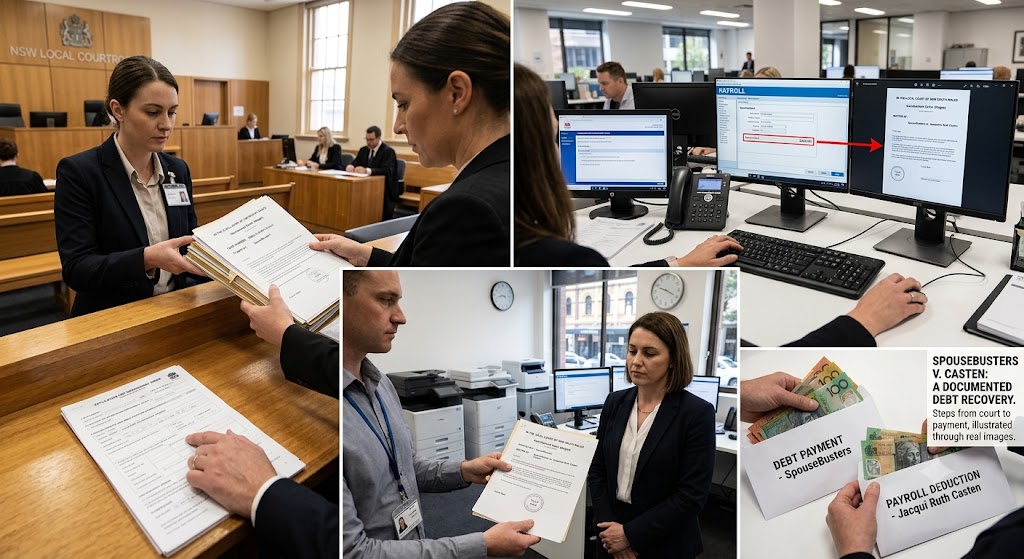
A garnishment order — formally called a Garnishee Order for Wages or Salary — is a court order that compels a debtor’s employer to deduct money from the debtor’s wages and pay it directly to the creditor until the debt is fully satisfied. The debtor has no say in the matter once the order is in force. The employer is legally obligated to comply.
It is one of the most effective debt recovery tools available to small businesses in NSW because it bypasses the debtor entirely. You are not relying on the debtor to willingly make payments. You are going directly to the source of their income.
Important: Before you can apply for a garnishment order you must first obtain a judgment from the court confirming the debt is owed. The garnishment order is an enforcement tool that comes after judgment — it is not the first step.
The Step by Step Process in NSW
Step 1
Lodge a Claim with the NSW Local Court
For debts under $20,000, file a Statement of Claim through the NSW Online Registry at onlineregistry.lawlink.nsw.gov.au. The filing fee is under $100 for small claims. You do not need a solicitor, though having one strengthens your documentation significantly. State the amount owed, the basis for the debt, and provide all supporting evidence — invoices, communications, and records of work performed.
Step 2
Serve the Defendant
Court documents must be formally served on the defendant — delivered in person or via a process server. If the defendant is evasive or difficult to locate, you may need to apply for a Substituted Service Order, which allows documents to be served via an alternative method approved by the court. This is where investigative skills become directly relevant to the legal process.
Step 3
Obtain Judgment
If the defendant does not respond to the Statement of Claim within the prescribed timeframe, apply for a Default Judgment — the court rules in your favour without the defendant appearing. If the defendant contests the claim, the matter proceeds to a hearing where a magistrate determines the outcome.
Step 4
Locate the Debtor’s Employer
To enforce a wage garnishment you must know where the debtor works. This is not always readily available — particularly with debtors who have deliberately made themselves hard to find. A licensed private investigator can legally locate a debtor’s current employer through surveillance, inquiries and database searches. This step is often the critical link between obtaining judgment and actually recovering money.
Step 5
File a Notice of Motion for Garnishee Order
Once judgment is obtained and the employer identified, file a Notice of Motion for Garnishee Order through the Online Registry. This requires an affidavit confirming the judgment amount, that no payments have been received, and identifying the proposed garnishee. The motion can be dealt with in the absence of the parties — the debtor does not need to attend or be notified before the order is made.
Step 6
Serve the Garnishee Order on the Employer
Once the court issues the garnishee order, it must be formally served on the employer. From that point the employer is legally obligated to deduct from the debtor’s wages and pay the creditor within 14 days of each pay period until the full amount is recovered. Non-compliance by the employer can result in judgment being entered against the employer themselves.
Cost to pursue this process: Filing fees in the Small Claims Division are typically under $100. Solicitor fees if used are additional. The total legal cost through to garnishment order is often $500–$1,500 — modest relative to most commercial debts being recovered.
Real Case Documentation — Local Court of NSW, 2021
SpouseBusters vs Jacqueline Ruth Casten
Case Number 2020/00347063
The following is a documented account of debt recovery proceedings taken by Triumph Australia Pty Ltd trading as SpouseBusters Australia against a client named Jacqueline Ruth Casten, who refused to pay for private investigation services legitimately performed and authorised.
Background
In July 2020, SpouseBusters was engaged by Jacqueline Ruth Casten to conduct surveillance investigating the whereabouts of her former partner. She had been a paying client on prior smaller jobs, which established credibility. The investigation expanded significantly from its original scope — Casten directed surveillance personnel in real time across multiple days, travelling past the Blue Mountains and to Oberon as the subject moved. She was informed of costs throughout, approved the continuation of work at each stage, and at one point physically travelled to Oberon herself where she was guided to the subject’s location in person by our investigator.
Payments came from multiple accounts via different methods. Initial payments established credibility. Subsequent transfers were delayed or failed to clear. Over the following weeks Casten provided a sequence of evolving payment excuses — superannuation funds, trust funds, car sales, banker transfers — none of which ever resulted in actual payment reaching SpouseBusters’ account. When legal proceedings commenced she disputed the debt, claiming she had not authorised portions of the work — a claim contradicted by months of documented SMS communications, phone calls, her active direction of investigators throughout the engagement, and her physical presence at surveillance locations.
Locating the Debtor
Casten proved difficult to locate for the purpose of serving court documents and identifying her employer. SpouseBusters applied its investigative capabilities — electoral roll searches, public records databases, skip tracing, and human intelligence inquiries — locating her current address at 1 Lethbridge Street, Penrith NSW 2750 and identifying her as an employee of Anglicare Op Shop across two Western Sydney premises. A Substituted Service Order was granted on 29 January 2021 allowing court documents to be served via her known email addresses after physical service proved impossible due to her evasive movements between premises.
Court Proceedings and Official Order
Jacqueline Ruth Casten did not appear or respond to the proceedings. Default Judgment was ordered against her on 4 March 2021. A Notice of Motion for Garnishee Order was filed on 8 March 2021, supported by a sworn affidavit from solicitor Julian Cesta-Incani of CVC Law, Wollongong. The garnishee order was issued the following day.
| Court | Local Court of NSW — Small Claims Division |
| Registry | Wollongong |
| Case number | 2020/00347063 |
| Plaintiff | Triumph Australia Pty Ltd trading as SpouseBusters Australia |
| Defendant | Jacqueline Ruth Casten |
| Garnishee | Anglicare Op Shop, Baulkham Hills NSW 2153 |
| Judgment debtor address | 1 Lethbridge Street, Penrith NSW 2750 |
| Default judgment date | 4 March 2021 |
| Garnishee order issued | 9 March 2021 |
| Amount ordered | $6,730.27 |
| Solicitor for creditor | Julian Cesta-Incani, CVC Law Wollongong |
| Issued by | Registrar A. Giles, Local Court of NSW |
The garnishee order directed Anglicare Op Shop to deduct wages payable to Jacqueline Ruth Casten and remit them to SpouseBusters within 14 days of each pay period until the full amount of $6,730.27 was recovered. The order was issued under Form 71 UCPR 39.37 and carried the full authority of the NSW court system.
⚖️ The Local Court of NSW ruled entirely in SpouseBusters’ favour. Default judgment was entered against Jacqueline Ruth Casten on 4 March 2021. The Garnishee Order for Wages or Salary issued on 9 March 2021 confirmed that the debt was legitimate and legally enforceable. The court documents are on public record under case number 2020/00347063, Wollongong Registry.
What Happens When a Garnishment Order Does Not Immediately Recover Funds
Obtaining a garnishment order is a significant legal victory — but it is not always the end of the matter. A debtor who becomes aware that a garnishment order has been served on their employer may change jobs, reduce hours, or move to cash employment to avoid the order taking effect.
Important: A garnishment order attaches to a specific employer at a specific time. If the debtor changes employment, a new order must be filed against the new employer. The legal judgment however does not expire — it can be enforced at any time the debtor’s current employer can be identified, for years after it is issued.
In circumstances where a debtor actively evades enforcement, ongoing investigative work to track their current employment becomes necessary. The legal win establishes your right to the debt beyond dispute. The recovery then requires persistence and, in some cases, continued investigative work.
Key Takeaways for Small Business Owners
- Do not write off unpaid debts — the NSW court system provides accessible and affordable enforcement tools
- Preserve all evidence from the first sign of non-payment — communications, invoices, payment records
- A Default Judgment can be obtained without the debtor appearing — non-response is not a shield against judgment
- Locating a debtor’s current employer is a critical step — investigative services can legally obtain this when the debtor is uncooperative
- A court judgment does not expire — pursue enforcement whenever assets or employment can be identified
- The total cost of pursuing a debt through to garnishment order is modest relative to most commercial debts
- Document every client communication in writing — SMS and email records were central to SpouseBusters’ case
- Substituted service orders allow proceedings to continue even when a defendant cannot be personally located

Written by Rob Jones, Senior Investigator at Spouse Busters. Rob has worked on infidelity, surveillance and locate cases across Australia, and the Spouse Busters team has been helping people find the truth since 2005. Licensed under GORA Investigations Pty Ltd, NSW Master Licence 412080174.