
How to Become a Private Investigator in 2026 (Training, Licensing, and Real-World Work)

If you’re thinking about becoming a Private Investigator in 2026, you’re probably picturing surveillance, sharp instincts, and finding answers people can’t get on their own. Some of that is true, but the job is less about movie scenes and more about a careful process.
Becoming a PI usually means three things at once: you get the proper training, pass background checks (often including fingerprinting), and hold the correct license for your state or territory. This process helps you build confidence in your qualifications and reassures you that your work will be respected and legitimate.
Rules vary across Australia, so you can’t copy someone else’s path step for step. You’ll get results faster if you treat it like a checklist and confirm licensing requirements with your local regulator before you spend money, ensuring you meet all legal criteria from the start.
What a Private Investigator Does in 2026 (and what you can’t do)
A Private Investigator is paid to find facts, not to “catch” people. Your core work sits in a practical lane: gathering information, confirming timelines, locating people, and documenting what you observe in a way that can stand up to scrutiny.
A private investigator can provide valuable assistance in various ways. Typical tasks include conducting factual investigations to check claims and events, locating subjects often referred to as “locates,” interviewing individuals, and taking comprehensive statements. They handle evidence with care to ensure its integrity. Additionally, they write detailed reports that explain their actions, the timeline of events, and the findings, all while using clear language and solid documentation. Think of your notebook like a seatbelt; it may seem unexciting, but it can be crucial when it prevents potential issues or misunderstandings.
In some cases, you’ll conduct covert surveillance where it’s legal. If you work surveillance, you also need to drive like any other road user. Following road and traffic laws is part of professionalism, not an optional extra.
Legal and ethical limits you must stick to
You’re not law enforcement, and your work has rigid boundaries. In general terms, you should expect limits like these:
- No trespassing or entering private property without permission.
- No illegal tracking or unlawful access to private accounts, devices, or communications.
- No pretending to be police or using fake authority to pressure people.
- Follow privacy rules, including those for collecting, storing, and sharing sensitive information.
- No unlawful recording or eavesdropping; consent rules differ by location.
If you’re unsure how surveillance stays lawful in practice, this guide on private investigators and privacy laws helps you think in the right direction.
Common cases you’ll handle as a Private Investigator
Most work is ordinary life, handled carefully. Depending on your clients and local demand, you may help with:
- Workplace matters (misconduct allegations, policy breaches, conflicts of interest)
- Locates for missing persons or hard-to-find witnesses
- Insurance or factual inquiries (checking circumstances, documenting activity)
- Relationship concerns (confirming facts for personal decisions)
You work for clients, but your methods still have to stay inside the law. When a client asks for something sketchy, you don’t “make it happen,” you explain the limit and offer lawful options.
Skills that make you employable fast
Training matters, but hiring managers also look for the basics you can’t fake:
Observation and patience: You’ll wait, watch, and notice small changes without rushing.
Clean report writing: Your notes and reports need to read like a timeline, not a story.
Interviewing: You stay calm, ask simple questions, and document answers accurately.
Basic tech comfort: You’ll use databases, case files, cameras, and secure storage.
Time management: You plan your day because cases rarely run on your schedule.
Discretion: You handle sensitive information so that loose talk can end your career.
4 Steps to become a private investigator in 2026
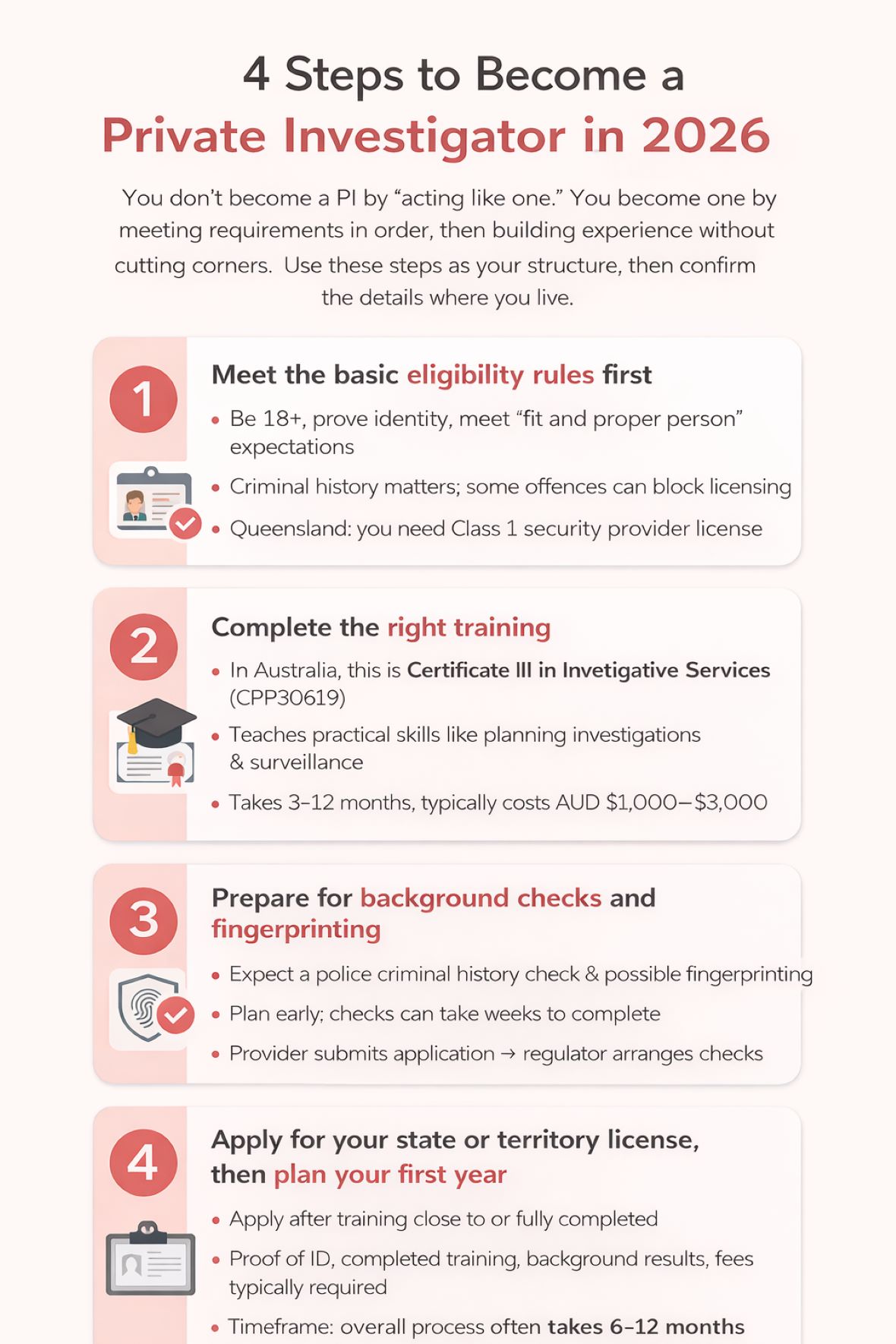
You don’t become a PI by “acting like one.” You become one by meeting requirements in order, then building experience without cutting corners. Use these steps as your structure, then confirm the details where needed.
1) Meet the basic eligibility rules first
Start with the non-negotiables. In most places, you’ll need to be 18 or older, prove your identity, and meet “fit and proper person” expectations.
Your criminal history matters. Serious offences can block licensing, and some regulators apply look-back periods (for example, certain offences within a set number of years). Even if a matter didn’t result in a conviction, you may still need to disclose it, depending on your regulator’s rules.
A concrete example: in Queensland, you need a Class 1 security provider license to work as a private investigator, which requires training and police checks.
2) Complete the proper training (Certificate III in Investigative Services)
In Australia in 2026, a common baseline is the CPP30619 Certificate III in Investigative Services. It’s designed around real tasks, not theory for theory’s sake.
You’ll cover practical skills such as planning investigations, locating subjects, interviewing and taking statements, writing factual reports, keeping official notes, handling sensitive information, and preparing evidence for court. The qualification also supports different focuses, including factual investigation work and surveillance work.
Typical timeframes and costs depend on how you study:
- Time: about 3 to 12 months (full-time study is faster, part-time takes longer)
- Cost: roughly AUD $1,000 to $3,000 (provider, delivery mode, and inclusions change the price)
Before you enrol, confirm your local licensing body accepts the provider and course outcome for licensing purposes. This step helps ensure your training meets legal requirements and prevents delays or invalid qualifications.
3) Prepare for background checks and fingerprinting
Most licensing pathways include a police criminal history check, and in some states, fingerprinting is required. This is one reason you should plan early because checks can take weeks.
In plain terms, you submit your application, then the regulator arranges checks. You may be directed to attend fingerprinting through police channels. If anything needs clarification, the regulator may ask for more documents before they assess you.
Queensland is a clear example: police take fingerprints as part of the process, and a criminal history check is required. If you refuse to provide fingerprints when needed, you won’t be issued a license.
4) Apply for your state or territory license, then plan your first year
Once training is completed (or close to completion, depending on local rules), you apply for your license with your state or territory authority. Most applications require:
- Proof of identity (often “points of ID” with certification rules)
- Evidence of completed training
- Completed application forms
- Check results (or permission for the regulator to obtain them)
- Payment of licensing and processing fees
A realistic overall timeline is often 6 to 12 months from starting training to holding a license, sometimes longer if you study part-time or if checks take longer than expected.
Budgeting matters too. A broad starter range across Australia is often AUD $1,500 to $5,000 once you add training, checks, and licensing fees.
Queensland fee examples (use these as a reference point, not a promise for your state): a criminal history check fee of $47.10, a fingerprinting fee of $109.60, and $91.20 to add the private investigator function to a Class 1 security license. Fees change, so confirm the current schedule before you lodge anything.
After you’re licensed, treat your first year like an apprenticeship you built for yourself: choose a niche, find supervision or mentoring if possible, tighten your report writing, and keep your work clean and lawful. Your reputation will travel faster than you do.
If you’re trying to understand what clients pay for investigations once you’re working, this Private investigator pricing guide is helpful context for how services are billed.
Final Thoughts on How to Become a Private Investigator in 2026

To become a private investigator in 2026, you need a simple plan you can follow: confirm your state or territory rules, finish the proper training, pass background checks (often including fingerprints and a criminal history check), then apply for the license and start building real experience. Stay legal, stay ethical, and let your notes and reports do the talking.
Your next step is straightforward: make a one-page checklist for your location, then contact your local licensing authority to confirm the current forms, fees, and processing times before you enrol or apply.
FAQ: Becoming a Private Investigator in 2026
How long does it take to become a private investigator?
For many people, training, plus checks and licensing, lasts about 6 to 12 months. If you study part-time, expect it to take longer. Delays also occur when documents need resubmission, fingerprints take time to schedule, or a regulator needs additional information to assess suitability.
Do you need a degree to become a Private Investigator?
A degree usually isn’t required. Approved vocational training is more common, and it’s built around the daily work you’ll actually do. What will set you apart is strong writing, calm interviewing, and basic tech confidence. If you can write a clear timeline and keep excellent notes, you’ll be employable faster.


