
 After separation, it is common to second-guess yourself. A repeated sighting, an unexpected message, a comment that feels too informed, or a device acting strangely can all be explained away one by one. But when those signs begin to form a pattern, the question changes. It is no longer just. Am I imagining this? It becomes, Is my privacy being compromised, and do I need to check properly?
A counter-surveillance check is not about panic. It is about practical verification. In Sydney and across Australia, post-separation concerns can involve hidden cameras, listening devices, tracking devices, spyware, compromised smart-home systems, or repeated monitoring that sits within a broader pattern of coercive control. Australian research and government guidance both recognise that technology is often used in post-separation abuse, monitoring, and intimidation (eSafety Commissioner; Australian Institute of Family Studies).
Why post-separation patterns matter
Separation does not always end monitoring. In some situations, it changes the form it takes. Instead of overt confrontation, the pattern may shift toward surveillance investigation, digital tracking, or information gathering that helps one person maintain control. Australian research has described technology-facilitated abuse as a serious feature of coercive control, especially where digital tools are used to monitor movement, communications, and day-to-day behaviour (Powell et al.; Australian Institute of Family Studies).
That matters because a counter-surveillance check is usually not triggered by a single suspicious event. It is triggered by a cluster of signs that begin to connect.
1) Someone keeps knowing things they should not know
One of the clearest warning signs is information leakage. This might look like:
- Your ex knowing where you were, even though you did not tell them
- Private plans are being raised in arguments
- comments that show knowledge of your schedule, visitors, or movements
- confidential work or legal information surfacing unexpectedly
- a child repeating details that were only discussed in a private setting
On its own, any one of these could be a coincidence. But when private information repeatedly reaches the same person, it is reasonable to ask how that information is travelling. In business contexts, unexplained leakage can also indicate concerns about physical or digital surveillance, especially when only a small number of people had access to the information in the first place.
2) You keep being “coincidentally” seen
Another common sign is repeated presence. This may involve:
- seeing the same car or person near your home, work, school, or gym
- your ex appearing in places without a clear reason
- being contacted immediately after a movement or outing
- feeling like your routine is somehow known in advance
eSafety describes cyberstalking and technology-facilitated abuse as behaviour that can make a person feel constantly tracked, monitored, or threatened. It also advises people to look for patterns rather than focusing only on individual incidents, because repeated coincidence can be a sign of monitoring rather than chance (eSafety Commissioner).
3) Your phone, accounts, or devices start acting differently
Not every device problem is a surveillance problem. Phones overheat, apps crash, and passwords get forgotten. But after separation, unusual tech behaviour deserves closer attention when it appears alongside other warning signs.
Possible indicators include:
- unknown apps or duplicated apps on your phone
- unexplained battery drain or overheating
- location services are turning back on
- account logins you do not recognise
- passwords changing unexpectedly
- unfamiliar Bluetooth or connected-device pairings
- smart-home settings changing without explanation
eSafety’s guidance on safely collecting evidence and on digital tracking specifically highlights spyware, tracking devices, smart-home systems, and connected technologies as tools that can be misused in abusive or controlling situations. It also recommends looking for patterns and documenting what you notice, rather than assuming the problem is random (eSafety Commissioner).
4) You are receiving alerts about tracking devices or unknown connections
This is one of the strongest practical signs. If your phone flags an unknown AirTag, Tile, or other tracking device moving with you, do not ignore it. The same applies if you discover an unfamiliar device in your vehicle, bag, child’s belongings, or around your home.
eSafety’s online safety guidance specifically advises people to check for unknown GPS trackers, Bluetooth devices, and unfamiliar smart-device connections when they suspect technology-facilitated abuse. It also notes that tracking can happen through vehicles and personal belongings, not just phones (eSafety Commissioner).
Counter-surveillance devices may be worth considering when the concern is no longer theoretical, and there is a real possibility that tracking hardware is involved.
5) Your car, home, or office no longer feels private
Counter-surveillance is not only about phones. Sometimes the concern sits in the physical environment. Warning signs may include:
- unusual objects, chargers, décor items, or power adapters that appeared without a clear reason
- signs that a vehicle has been tampered with
- smart speakers, cameras, or alarms behaving strangely
- unfamiliar wires, battery packs, or plug-in devices
- unexplained interference in private spaces
In NSW, the Surveillance Devices Act 2007 regulates the installation, use, maintenance, and retrieval of surveillance devices, including listening, optical, tracking, and data surveillance devices. That does not mean every unusual object is evidence of unlawful surveillance. It does mean that concerns about hidden or installed devices sit inside a real legal framework and should be taken seriously when the pattern supports it (New South Wales legislation).
6) The separation involved coercive control, intimidation, or stalking behaviours
Context matters. A counter-surveillance check becomes more relevant when the separation already includes:
- coercive control
- intimidation
- stalking
- threats
- family violence
- financial monitoring
- obsessive contact or repeated boundary violations
Australian policy and research literature has repeatedly linked post-separation abuse with monitoring and technology misuse. The AIFS review on coercive control notes that controlling behaviour often continues after separation and may include surveillance, stalking, and other methods of limiting a person’s autonomy. ANROWS’ national survey on technology-facilitated abuse also reinforces the point that monitoring and digital control are not fringe behaviours. They are established parts of abusive patterns in Australia (Australian Institute of Family Studies; Powell et al.).
If that broader context exists, a counter-surveillance check may be a sensible safety step rather than an overreaction.
7) You are changing your behaviour because you feel watched
A practical threshold many people overlook is this: Has the concern already changed how I live? If you are now:
- avoiding certain routes
- changing routines without wanting to
- leaving devices behind to feel safe
- withholding information from friends or family
- feeling unable to relax in your own home or office
Then the issue is no longer only psychological. It is already affecting your privacy, freedom, and daily decision-making. That matters because coercive control is partly about forcing a person to self-limit. A counter-surveillance check can help determine whether the concern is supported by evidence and whether there are concrete risks that need to be addressed.
What a counter-surveillance check is really for
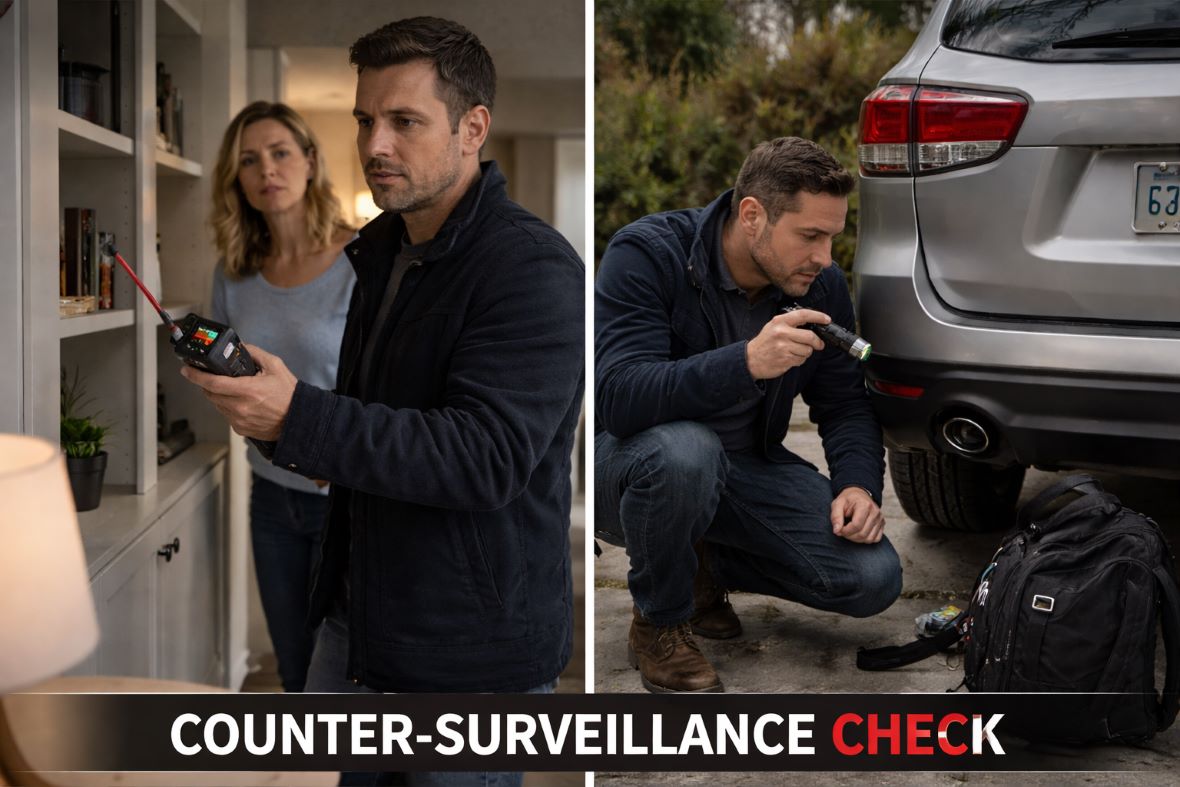
A counter-surveillance check is not a dramatic sweep for spy gadgets in the movie sense. At its best, it is a structured risk assessment of whether there are signs of physical or technology-based monitoring in your environment. Depending on the matter, which may involve:
- reviewing the pattern of suspected monitoring
- checking likely locations or objects of concern
- identifying unusual devices or signs of tampering
- documenting what is found and what is ruled out
- helping you understand what next step makes sense
Sometimes the result is confirmation that a risk exists. Sometimes the value is used to rule something out. Both outcomes matter.
What not to do
If you suspect monitoring after separation, avoid turning the situation into a rushed DIY search that could escalate risk or destroy useful evidence. eSafety’s guidance emphasises collecting evidence safely and thinking about device safety before making changes that might alert the other person. That is especially important where there is a history of coercive control or family violence (eSafety Commissioner).
A safer first response is usually:
- note the pattern
- record dates, times, and incidents
- keep screenshots or device alerts
- photograph suspicious objects without dismantling them
- seek legal, police, or specialist support if the risk feels immediate
When police should come first
A counter-surveillance check can be useful, but it is not always the first step. If the concern involves:
- immediate danger
- stalking with threats
- family violence
- fear of escalation
- a child’s safety
- clear evidence of unlawful monitoring or intimidation
then police and safety planning should come first. eSafety and other Australian guidance on domestic and family violence consistently stress safety-first responses when risk is active.
Conclusion
After separation, people often dismiss their own concerns because each sign seems explainable on its own. But privacy breaches are not always obvious in one dramatic moment. More often, they appear as a pattern: the repeated coincidence, the information leak, the strange device behaviour, the unfamiliar tracker alert, the home that no longer feels private.
That is when a counter-surveillance check becomes relevant. Not because fear should drive the response, but because patterns deserve verification. In post-separation situations, clarity is often the difference between feeling unsettled and knowing what you are actually dealing with.
FAQ
What is the clearest sign that I may need a counter-surveillance check after separation?
Usually, it is not one sign on its own. It is a recurring pattern, such as someone knowing private information, appearing unexpectedly where you are, or your devices and accounts behaving in ways that suggest monitoring.
Are tracking devices and spyware real risks after separation?
Yes. Australian government guidance specifically recognises tracking devices, spyware, surveillance systems, and smart technologies as tools that can be misused in abusive or controlling situations (eSafety Commissioner).
Should I search my home or car myself if I suspect surveillance?
It is usually safer to document what you notice first rather than rush to dismantle devices or confront someone. In higher-risk situations, especially where coercive control or stalking is involved, police or specialist support may be the better first step.
References
Australian Institute of Family Studies. (2024). What the research evidence tells us about coercive control.
eSafety Commissioner. (2025). Collecting evidence safely.https://aifs.gov.au/resources/policy-and-practice-papers/what-research-evidence-tells-us-about-coercive-control/
eSafety Commissioner. (2025). Cyberstalking. https://www.esafety.gov.au/key-topics/domestic-family-violence/collecting-evidence-safely/
eSafety Commissioner. (2025). Online safety checklist.
New South Wales legislation. (n.d.). Surveillance Devices Act 2007 No 64.https://legislation.nsw.gov.au/view/whole/html/inforce/current/act-2007-064/
Office of the Australian Information Commissioner. (n.d.). The Privacy Act.
Powell, A., Flynn, A., & Hindes, S. (2022). Technology-facilitated abuse: National survey of Australian adults’ experiences. ANROWS.


