
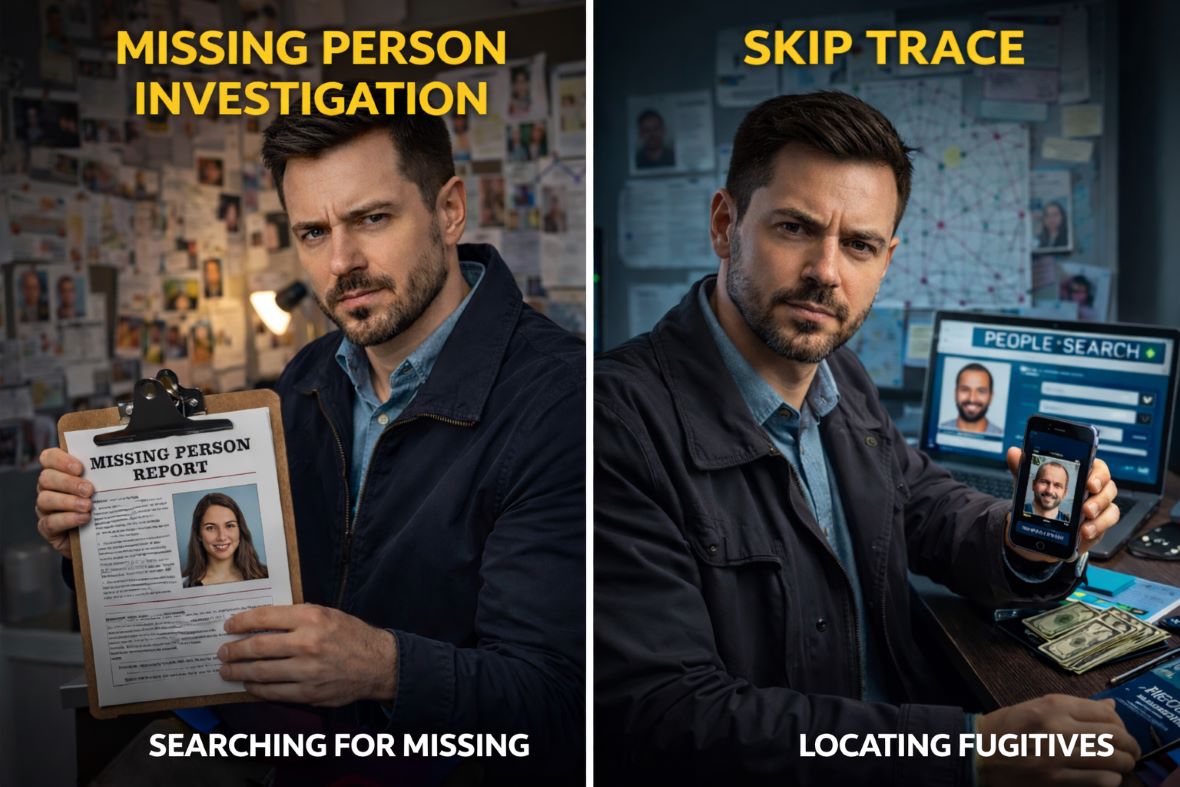
When someone disappears, the first question is not always “Who can find them?” It is often “What kind of investigation do I actually need?” In Australia, a missing person investigation and a skip trace can overlap, but they are not the same thing. If there are real concerns for a person’s safety or welfare, police should be involved quickly. If the goal is to lawfully locate someone who has gone quiet, moved, or become difficult to find for practical reasons, a skip trace may be the more suitable approach.
The short answer
Choose a missing person investigation when the situation is urgent, welfare-related, emotionally serious, or potentially unsafe. Choose a skip trace when the main issue is locating someone for a practical next step, such as reconnecting, resolving a tenancy matter, following up on a legal issue, or tracing a spouse or partner who has disappeared from contact. SpouseBusters positions missing-persons work around urgency and care for loved ones, while its skip tracing service is framed around locating hard-to-find people and avoiding wasted time on dead-end leads (SpouseBusters).
Start here first: Is this a welfare concern?
If you are concerned that the person may be in danger, vulnerable, mentally unwell, or otherwise at risk, this should be treated as a missing person matter first, not simply a tracing exercise. The National Missing Persons Coordination Centre explains that you can file a missing person report at your local police station if you have concerns about someone’s safety and welfare, and it stresses that the first 24 hours are crucial, as early police follow-up can preserve leads, such as CCTV footage and other time-sensitive information. The Australian Federal Police also make it clear that state and territory police are the lead agencies for individual missing-person investigations in Australia (National Missing Persons Coordination Centre; Australian Federal Police).
What a missing person investigation is really for
A missing person investigation is the right fit when the core issue is uncertainty around someone’s whereabouts and wellbeing. This may involve a missing family member, a partner who has vanished under concerning circumstances, an adult with addiction or mental health issues, or a loved one whose disappearance feels unsafe or out of character.
Signs you are dealing with a missing person matter
- there are concerns for the person’s safety or welfare
- the disappearance is sudden, unusual, or out of character
- there is reason to think the person may be vulnerable
- time matters because recent movements, CCTV, transport, or digital clues may disappear quickly
- the family needs both a reporting path and structured follow-up rather than a simple location check
If the situation feels urgent, welfare-led, or potentially unsafe, this is usually not the time to treat it as a routine tracing exercise.
What a skip trace is really for
To explain skip tracing, it is typically the best method for locating someone who is difficult to find. This situation often arises from practical concerns rather than emergencies. According to SpouseBusters, a skip tracer is a professional investigator who tracks down individuals who have intentionally or unintentionally gone missing, often to avoid legal or financial responsibilities. The skip tracing process may involve using databases, conducting interviews, analyzing patterns, and validating information to identify reliable leads (SpouseBusters).
Signs you are dealing with a skip tracing matter
- the person has changed address, phone number, workplace, or routine
- there is no immediate safety concern, but you still need to locate them
- the reason is practical, such as a family, tenancy, debt, or relationship matter
- you need a lawful tracing process, not an emergency response
The practical difference in one sentence
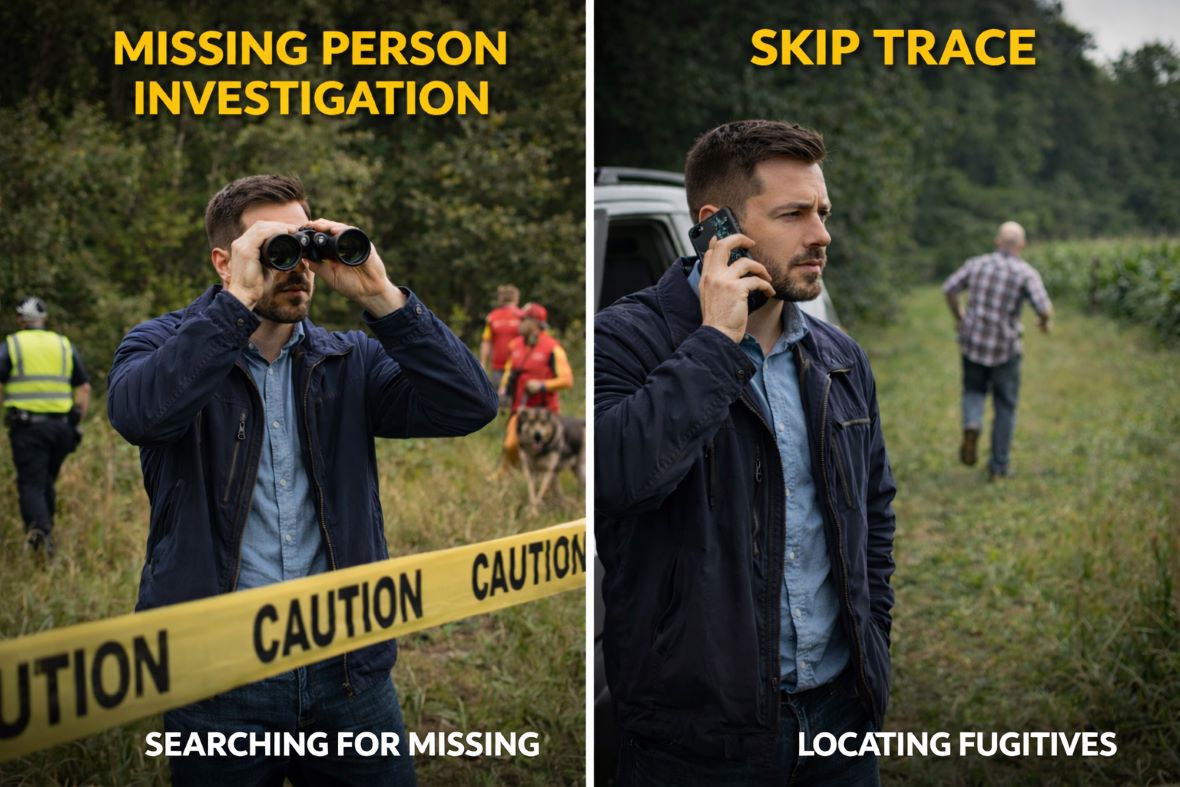
A missing person investigation is welfare-led and urgency-driven. A skip trace is location-led and outcome-driven.
In real life, some cases begin as one and become the other, but choosing the right starting point matters because it changes who should be involved first, what information you gather, and how quickly action should happen.
A simple decision framework
Choose the missing person path if:
- you fear the person may be harmed, unsafe, or in crisis
- the disappearance is recent and unusual
- family or friends are deeply worried about welfare
- you need police involvement quickly because time-sensitive evidence may exist
Choose the skip tracing path if:
- the person appears to be avoiding contact rather than missing in a welfare sense
- you need to find a current address, workplace, or reliable contact trail
- the issue is linked to a family, tenancy, debt, or relationship matter
- the main need is verified location information, not an emergency response
What information helps in either case
The more accurate information you have at the start, the better. The National Missing Persons Coordination Centre recommends collecting practical identifying details such as recent photos, vehicle details, contact information, known associates, social media activity, and recent movements. That same disciplined starting point also improves a skip trace, because strong inputs reduce false leads and make validation easier (National Missing Persons Coordination Centre).
Useful information includes:
- full name and known aliases
- recent photo
- last known address and workplace
- phone numbers and email addresses
- vehicle details
- known friends, relatives, and associates
- recent social media activity
- the last confirmed contact and why you are concerned
The privacy and lawful boundary piece
In Australia, locating and investigating people still sits inside a privacy framework. The Office of the Australian Information Commissioner explains that the Privacy Act 1988 regulates how many organisations and agencies handle personal information, and it has also published guidance around people reported as missing. That does not mean a lawful investigation cannot happen. It does mean that the work should remain within proper legal and ethical boundaries, especially when sensitive information is involved (Office of the Australian Information Commissioner).
For SpouseBusters, that means using the right service for the right objective and avoiding any assumption that a private investigator can do “anything.” Missing persons work is framed around urgency and care. Skip tracing is grounded in lawful resources, validation, and investigative skills.
A useful rule for families and businesses
If the problem is “I’m worried they are not safe,” start with the missing person pathway.
If the problem is “I need to locate them for a legitimate next step,” start with skip tracing.
That one distinction can prevent wasted time and help you explain the matter clearly to police, a lawyer, or an investigator.
FAQ
What is the main difference between a missing person investigation and a skip trace?
A missing person investigation is usually welfare-focused and should involve police where safety is a concern. A skip trace is usually a lawful process for locating someone who is difficult to find for practical reasons, such as family, tenancy, debt, or relationship matters.
Can skip tracing be used to find a missing spouse or partner?
Yes, in some cases. SpouseBusters specifically describes skip tracing as a service that can help locate a missing spouse or partner, especially where the issue is tracing rather than an immediate safety emergency.
What details should I gather before starting either process?
Useful information includes recent contact details, known addresses, workplace information, social profiles, associates, vehicle information, and the last confirmed contact. The National Missing Persons site lists similar information for police reports because it helps narrow the search quickly.
References
Australian Competition and Consumer Commission, & Australian Securities and Investments Commission. (2021). Debt collection guideline: For collectors and creditors. https://www.accc.gov.au/system/files/Debt%20collection%20guideline%20for%20collectors%20and%20creditors%20-%20April%202021.pdf
Australian Federal Police. (n.d.). Missing person investigations in Australia and overseas. https://www.afp.gov.au/our-services/national-policing-services/missing-persons
National Missing Persons Coordination Centre. (n.d.). How to report a missing person? https://www.missingpersons.gov.au/how-report-missing-person
Office of the Australian Information Commissioner. (2024). Guide to the Privacy (Persons Reported as Missing) Rule 2024. https://www.oaic.gov.au/privacy/privacy-guidance-for-organisations-and-government-agencies/handling-personal-information/guide-to-the-privacy-persons-reported-as-missing-rule-2024
Office of the Australian Information Commissioner. (n.d.). The Privacy Act. https://www.oaic.gov.au/privacy/privacy-legislation/the-privacy-act
SpouseBusters. (n.d.). Missing persons investigator – Expert locators. https://spousebusters.com.au/services/missing-persons-investigator/